Forgiveness
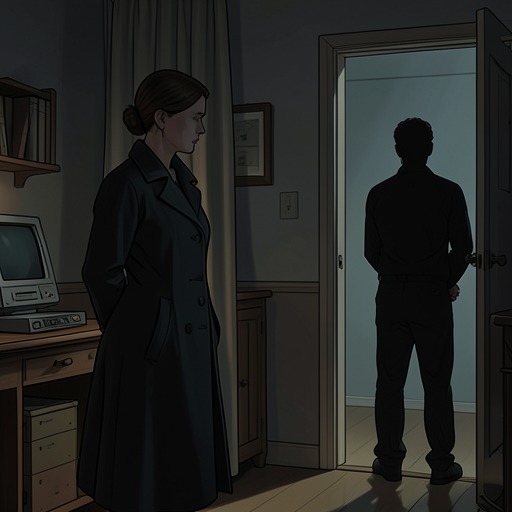
Falling For The CEO: BAD BOY ROMANCEForgiveness is presented as a demanding form of emotional judgment: it can acknowledge injury without pretending that the injury was insignificant. In Diana Jones and William King’s relationship, forgiveness must pass through two mirrored disclosures. Diana Jones admits that she concealed her employment at the Grace Hotel, while William King later reveals his marriage to Julia and the betrayal that ended it. The novel therefore treats reconciliation not as a return to romance by force of feeling, but as a negotiated movement from suspicion toward a more truthful future.
Betrayal, Secrecy, and the Demand for Truth
Forgiveness first becomes difficult because Diana Jones and William King have each experienced concealment from the other. Diana Jones had told William King that she was a tour guide without explaining that she worked at the hotel he managed. Her omission arose from fear: after discovering that the man she had flirted with was her brother Connor Jones’s boss, she worried that William King would think she had misled him deliberately or that the relationship would threaten her employment. She insists that the omission was not a plan to manipulate him, but an attempt to protect herself from being hurt.
William King experiences the omission differently. Because he is her employer and because Diana Jones had allowed him to believe that she rejected a relationship with him for professional reasons, he suspects that their intimacy may have been engineered to prevent him from dismissing her. His distrust turns the woman he loves into a possible stranger. When Diana Jones apologizes, she accepts responsibility for the lie and for the pain it caused, but she also explains its emotional origin: she acted defensively because the possibility of losing him frightened her. Her confession does not demand immediate absolution; it gives him the fuller context needed to judge what happened.
The scene is ethically important because William King initially refuses the comfort of familiarity. He tells Diana Jones that he does not know whether the person he fell for is real, while she answers that he knows who she is despite denying it. The conflict separates knowledge of a person from confidence in that person. Forgiveness cannot begin while the injured party treats the other’s entire identity as suspect, yet the novel also shows that apology alone cannot compel trust. Diana Jones can tell the truth and accept blame, but William King must decide whether the truth changes his understanding of her act.
William King’s Hidden Marriage and the Reversal of Judgment
The discovery of William King’s marriage to Julia reverses the moral arrangement between the lovers. Diana Jones had previously occupied the position of the person whose lie required explanation; now she learns that William King withheld a far more consequential part of his life. Her anger intensifies because he had been so severe about her concealment. The irony is not merely that both have lied, but that William King’s reaction to Diana Jones may have been enlarged by an older betrayal he had never disclosed.
William King explains that he stayed with Julia after learning that she was pregnant because he believed the child might be his and would not abandon it. At the doctor’s appointment, he discovered that the timeline made paternity impossible: he had been away at a conference for two weeks during the possible period of conception. He did not confront Julia in front of the doctor, then packed his bags and contacted a lawyer after they left the office. He has not seen her since the divorce.
Julia’s response deepened the wound. She first begged William King to stay and claimed that she loved him; when he refused, she lashed out and blamed him for not giving her enough attention. He understands this as another exposure of the selfishness he had failed to see before the marriage. The betrayal therefore remains active in his present relationship, even though the marriage has ended. His silence protects him from revisiting humiliation, but it also leaves Diana Jones without the information needed to understand why his earlier anger was so disproportionate.
Diana Jones responds with compassion rather than simple condemnation. She sees the brokenness in William King’s account and recognizes that he had reasons for finding the past difficult to share. Yet she refuses to convert sympathy into an excuse. She can forgive the fact that he lied, especially because she would be hypocritical to demand a standard she had failed to meet herself, but she cannot ignore what the lie concealed: a marriage, a failed pregnancy-related relationship, and the unresolved trauma that shaped his response to her.
Conditional Forgiveness and the Boundary of Separation
Diana Jones’s most significant act of forgiveness is also an act of refusal. She tells William King that she is not Julia, but fears that he may treat her as though she were Julia until he works through what happened. She therefore establishes a condition for reconciliation: he must confront his feelings rather than carry them unexamined into their relationship. Her decision acknowledges love while denying love the power to cancel psychological danger.
This boundary changes forgiveness from passive tolerance into self-protection. Diana Jones does not punish William King by withholding affection, nor does she claim that his suffering is unreal. She listens, accepts his apology, and says that she believes she has forgiven the lie. What she cannot accept is a relationship in which his unresolved suspicion repeatedly makes her answer for Julia’s betrayal. The separation gives him space to heal and gives Diana Jones space to determine whether waiting is an expression of hope or another form of fear.
Her own history explains why this boundary is difficult. After the deaths of her parents, Cora Jones and Derek Jones, Diana Jones fell into deep depression. Their deaths occurred just before her final first-year examination; although she insisted on writing it, she later lost a university scholarship and friends and could not return for her second year. Connor Jones eventually forced her into work at the Grace Hotel, where she discovered that guiding guests through Cape Town’s history and culture allowed her to live again rather than merely survive.
That recovery remains vulnerable to abandonment. Six years after her parents’ deaths, Diana Jones still feels alone and not fully independent, despite Connor Jones’s support. Her parents did not leave willingly, but their absence nevertheless became an experience of being left. The same fear enters her relationship with William King and initially makes her cling to the possibility that he will leave. Forgiveness becomes part of her growth because she learns to separate love from surrender: she can forgive William King and still refuse to remain with him until he is ready.
Waiting, Healing, and the Possibility of Reconciliation
The period of separation is not represented as a clean cure. Diana Jones misses William King, avoids him at work, and struggles whenever their brief encounters reveal that he is disappointed as well. At home in Camps Bay, she gardens after weeks of emotional unrest and sixty-hour workweeks, using the neglected garden as a tangible measure of how completely the relationship had occupied her life. The physical act of pulling weeds gives shape to feelings that work had allowed her to postpone.
Diana Jones alternates between believing that separation is right and fearing that she has abandoned the best thing that happened to her. She recognizes that a few months earlier she might not have allowed William King time to heal, because the fear that he would never return would have controlled her. Now she chooses to wait without making her life wholly dependent on the result. She tells herself that she will cherish what the relationship gave her even if it ends, yet she also admits that she loves him and would wait for him. This tension makes her forgiveness active but not secure: it opens her to hope while preserving the possibility of loss.
William King’s eventual return carries moral weight because it follows recognition rather than mere desire. He acknowledges the pain he caused Diana Jones, regrets it deeply, and admits that he married the wrong woman. More importantly, he identifies the change in his own understanding: he had not fully realized how much Julia’s betrayal governed him until the possibility of losing Diana Jones exposed it. He asks to begin again without the lie between them and later asks for another chance, promising that the future will be about the two of them.
Diana Jones’s joyful acceptance does not erase the earlier damage; it marks the result of having confronted it. Her tears change from pain to joy only after William King expresses certainty that he is ready for her and for their future. Their reunion is therefore a form of conditional reconciliation: the relationship resumes because the hidden past has been spoken, the injury has been named, and the person who caused the new injury has begun to understand the old one.
Narrative Significance
The novel’s model of Forgiveness depends on witnessing. Diana Jones’s apology matters because she gives William King an account of the fear behind her concealment, while William King’s confession matters because he finally allows Diana Jones to see the betrayal and abandonment beneath his defensiveness. Neither disclosure automatically repairs trust. Each must be heard, interpreted, and answered by a choice.
Forgiveness also connects romantic conflict to inherited experiences of abandonment. Diana Jones carries the death of Cora Jones and Derek Jones into her fear of being left, while William King carries Julia’s betrayal and the earlier abandonment associated with his family history into his distrust of romantic partners. Their love cannot heal these wounds simply by existing. It can become healing only when both characters stop asking the other to absorb the consequences of an earlier relationship.
The final reconciliation thus preserves the seriousness of betrayal while allowing renewed intimacy. Diana Jones does not forgive by forgetting, and William King does not receive another chance merely because he is remorseful. Forgiveness becomes credible when truth is followed by responsibility, responsibility by distance and healing, and healing by a deliberate request to begin again. In that structure, reconciliation is not the denial of damage but the possibility of trusting after damage has been fully recognized.